Location

1155 FM 518
Kemah. TX 77565
281-334-0815
sales@triadmarine.com
Showing posts with label texas. Show all posts

Wednesday, May 11, 2011

Sold Boats for the Week

Today we delivered 2 boats from 2 different manufactures for 2 totally different purposes. Inflatable boats just have that sort of versatility.

This is an Achilles SG156 Inflatable Boat that will be used by a Fire Department in Magnolia Texas.


This boat typically comes open and is used with a tiller handle motor, but at Triad Marine we can customize your inflatable boat to meet your needs. We added a jockey style console seat with remote steering for the motor. We hope this boat has many good years on the water working because that is what it is for.

The next boat to leave the store sold is a Zodiac Pro Open 650
This boat will be used as a coaching boat for kids that sail, not by the sailing organization but by their parents. The mom plans to use it to capture good pictures of the kids doing their thing.

The boat is 21'4" and is powered by a Yamaha F150 Outboard Motor. This boat will be fast, stable, and fuel efficient. It will not require a large tow vehicle and can also be used for some family fun.
The removable tube set on this boat makes it a real winner as it can be replaced if needed and it can be removed for repair if a customer lives far away from here. They would be able to ship just the tube set using UPS or Fed Ex rather than bringing the whole boat.

Meet "Jibby" as it will be called


Happy Boating "Jibby"


Monday, February 28, 2011

EPIRB and PLB Spring Check List

If you read THIS POST last week then you know we are trying to help you check the safety gear on your boat before Spring arrives and lots of boating gets under way. This week will will focus on EPIRBs and PLBs. Both EPIRBs (Emergency Position Indicating Radio Beacon)  (**note that the link is very helpful but a bit dated as the 121.5 MHz signal is no longer monitored as an emergency response signal and is now used as a fly over homing signal only**)and PLBs (Personal Locator Beacon) operate in the same way. There are differences including a longer battery life, floatation and deployment options, but they all have a battery life and expiration date! 

EPIRBs and PLBs operate on the 406 MHz frequency, if you still have 121.5 EPIRB you will need to replace it.
Starting on 1 February 2009, the Cospas-Sarsat System stopped processing signals from the deprecated 121.5 MHz and 243 MHz beacons; now only signals from 406 MHz beacons are processed. The switch to 406 MHz is expected to result in a substantial reduction in wasted use of SAR resources on false alerts while simultaneously increasing the responsiveness of the system for real distress cases.


If you have an EPIRB or PLB locate the battery expiration date and check it.
If you do not have one you should strongly consider purchasing one.
The gentleman in this post was not going to buy one but we encouraged him to purchase at least a PLB and it saved his life.

EPIRBs have to have a minimum battery life of 48 hours, they are designed to float in the water up right and transmit a signal, they also have a tether line to tied them to you or your life raft. EPIRBs come in Manual Deployment Versions and Automatic Deployment Versions. The Automatic Deployment EPIRBs have a housing and a Hydrostatic release unit that will set the EPIRB off and release it from the housing, allowing it to float to the surface and transmit. EPIRBs are also available with and with out a GPS transmitter built in. The GPS will help narrow down the search area.

PLBs will have a minimum operation time of 24 hours, they all have to be manually deployed and even though some models float they are not designed to float up right and transmit in the water like and EPIRB. PLBs usually have to be held with the antenna facing the sky. This doesn't mean your signal would not transmit if there was not a clear view of the sky, it is simply the best case scenario. Most PLB models have the built in GPS transmitter which will give rescuers a better idea of exactly where the user is.

So the check list is as follows:
Be sure the EPIRB is a 406 MHz and not a 121.5 MHz operating unit. It is OK to have both.
Be sure the battery is not expired
If the battery is expired find a factory authorized replacement center in your area.
Preform the manufactures self test
If it is an Automatic Deployment Unit check the date on the Hydrostatic Release
(good for 2 years)
Make sure the Housing is in working condition
For PLBs
Check the battery and perform the self test.

Safe boating is the best boating. Come back later in the week as we highlight some rescue stories and introduce you to AMVER (Automated Mutual-Assistance Vessel Rescue System , there are some rescue stories like these that resulted because of AMVER.

Also don't forget to fan us on Facebook for our Daily Deal section of our Website using QR Code and a password only fans get... the savings are Awesome!!


Tuesday, February 22, 2011

PFD Talk - Spring Safety Check List for Leisure Boating

I would like to talk about PFDs (personal flotation devices), they are required for all boaters by the USCG. With Spring approaching it is a good idea to start checking all of your boating safety gear, my suggestion is start with you PFDs. Inspect each one for rips, tears, holes and frays at the seams. Check all straps and hardware for damage, check the buoyant materials for shrinkage and damage, and finally put it on and check to ensure it still properly fits from last boating season.

The USCG recreational boating requirements for PFDs are different than commercial vessel requirements and are the same across the board for children. All children must be wearing a PFD while on the boat.
Bellow are the rules for recreational boaters in our home state of Texas. Always check your state's laws about boating, also remember to check out boating rules if you will be traveling and boating as they may not be the same.

Texas PFD Requirements

  • Children under 13 years of age in motorboats under 26 feet must wear a U.S. Coast Guard approved PFD while underway.
  • All vessels under 16 feet (including canoes and kayaks) must be equipped with one Type I, II, III or V for each person on board.
  • Vessels 16 feet and longer, in addition to the Type I, II, III or V for each person on board, must have one Type IV which must be readily accessible. Canoes and kayaks over 16 feet are exempt from the Type IV requirement.
So now we can talk about leisure boating and PFDs the USCG has a great informational page on PFDs you can CLICK HERE to visit. They have advice on how to choose a properly fitting PFD, checking them, caring for them and great information about cold water survival all in one place. There is a whole section that describes each "Type" of  PFD for Example a Type I is Best for all waters, open ocean, rough seas, or remote water, where rescue may be slow coming.  Abandon-ship life jacket for commercial vessels and all vessels carrying passengers for hire.

Type I PFD

Besides the USCG Type given to the PFD there are a couple of styles of PFD traditional inherently buoyant and Inflatable. Both styles have a Type given to them and can be identified at the time of purchase.
Inflatable PFDs are not for use by persons under age 16 as they may not be able to fully understand their operation. This means someone under age 16 will likely not understand how to manually activate the inflatable PFD if the auto activation should fail.

Mustang Inflatable PFD MD3184
Revere Comfortmax Plus Inflatable PFD

Revere general boating inherently buoyant PFD

The best PFD is always one they you are wearing and fits properly. This gives inflatable PFDs the advantage because they are more comfortable. For leisure boating in Texas carrying a life jacket of the proper type meets the requirements but will not save your life if you go overboard without it.
Many inflatable PFDs have 34-35 pounds of buoyancy where most standard non-inflatable PFDs only provide between 15.5 and 22 pounds of buoyancy depending on the type.

I would like to introduce you to the Mustang Survival MD0450 Inflatable Vest PFD with LIFT (Life-saving Inflatable Flotation Technology) This vest features Auto Hydrostatic Activation and has 40 pounds of Buoyancy when inflated. This is a high quality inflatable PFD designed to meet the needs of offshore boating. You can purchase high quality Mustang Survival products from Triad Marine.


Spring is around the corner and as we prepare the boats for another season of fun we need to make sure we are checking the boat's safety equipment. Check your PFDs and replace damaged ones. Consider purchasing at least one new safety item every Spring to accompany the current safety gear. There is always room for a PFD you will wear on every boat.

Please feel free to contact us if you need help choosing a PFD or any safety equipment for your boat. Also remember regulations and laws change from time to time so it is a good idea to check each Spring to make sure you are in compliance.
Happy and Safe Boating!


Thursday, February 17, 2011

Life Raft Servicing is Important

In this post I discussed why you should service your life raft, Today I would like to touch on the subject of servicing again. Servicing the life raft is the life of the raft, we see several life rafts come in that have not been serviced in several years and many times this results in putting a really good life raft out of commission or a really high servicing bill.

Some things to keep in mind about serving is that when you bring a life raft to a service station a technician will open the life raft and inspect it for malfunctions, air tests will be performed and all parts of the life raft and equipment are inspected and replaced if they are deemed out of date or non-functioning. If your life raft cannot be certified as safe and usable it will be decommissioned.

Keep in mind there are items in a life raft they can cause problems, recently we opened a life raft that had corroded batteries in the flash light. The battery acid had eaten through the flash light and gotten all over much of the equipment. Imagine finding this out on the ocean instead of at the shop. This particular life raft was 7 years overdue for servicing.


Life rafts are as important to a boat as the brakes on a car and like the brakes they need to be serviced. For more information on life raft servicing or to visit our store and see an open life raft contact us. We are proud to support Maritime Safety and Education through community outreach; we take pride in not just selling and servicing a product but educating customers on how to use a product.

Thursday, January 27, 2011

Inflatable Boats- Not Just Dinghies

Many boat buyers see inflatable boats as just dinghies and move on, but there are inflatable boats for all applications.
There are inflatable boats you can use in the rivers
Such as high quality Achilles River Boats

There are inflatable boats you can use with you RV
Such as the Zodiac Cadet Compact and Achilles HB300FX
Both have a folding transom and stow fairly flat making them ideal for motor homes and RVs, but if you need something that folds up even smaller you can get boats such as
Zodiac Fastroller ACTI-V and the Achilles LSI Models

A great weekend boat or tender is an Inflatable with wooden or aluminum floor boards, the floor boards provide better rigidity than an air floor boat (when properly inflated) but the boat will still break down to stow in a relatively small space some of the models you may consider are
Zodiac Cadet , Achilles SPD, and Achilles LEX

Looking for a Rigid Hull Tender (RIB) for your boat or to use in the lake, you can choose from models
Like these
Achilles HB Series Boats, Zodiac Cadet RIB Series Boats and Caribe C Series Boats

But most people know about those models and what you can do with them, people want to know about bigger boats ones you can fish from, pull someone on a tube in, relax and sunbathe in and use as a main family boat
You could look to these models to fill those needs
Zodiac Pro Series Boats
Zodiac Pro Open Series Boats
Zodiac Bay Runner Series Boats

Inflatable boats also serve as commercial use boats world wide in everything from Swift Water Rescue to transport boats. Companies and individuals turn to the stability of inflatable boats when they want the safest boats. Inflatable boats are more buoyant than aluminum boats that are often used in the same applications.
If you are considering an inflatable boat and need more information call us, we are the inflatable boat experts. Triad Marine opened in 1992 and our owners come from the back grounds of inflatable boats and life rafts. With so much experience under one roof you are sure to learn something about inflatable boats, amd hopefully decide to become the owner of one!
Enjoy some pictures of boats Triad Marine has put on the water

Zodiac Pro Open 650

Achilles HB350LX w/ Eurohelm

Achilles HB240LX

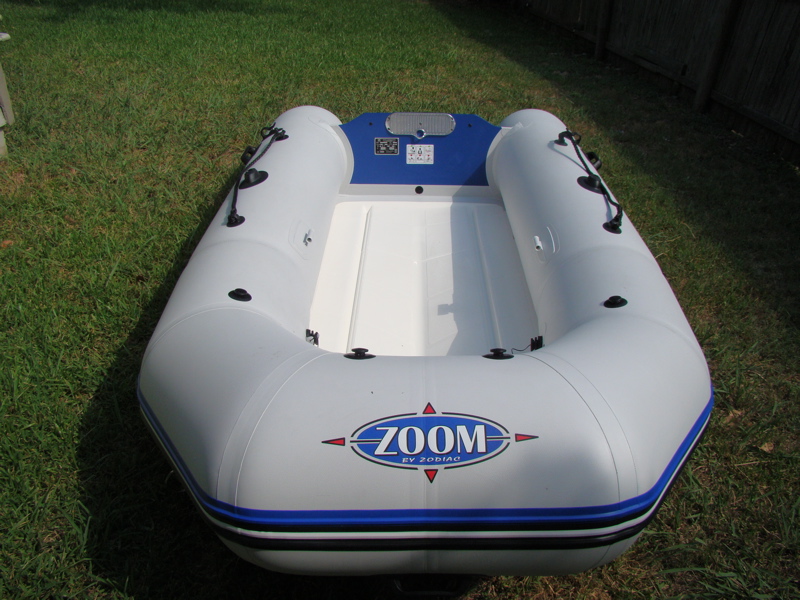
Zodiac Zoom 310SR

Zodiac Zoom 310SR in Bag

Zodiac Pro 550 (12 Man)
Used by Jamaica Beach Fire Department

Zodiac FC420

Zodiac FC530

Zodiac CZ7

Zodiac FC470

Caribe C13

4 Zodiac FC420 Boats to be used in Dallas by the Fire Rescue

Zodiac Pro 550 (12 man) Leisure Application


Achilles FRB 124

Tuesday, January 25, 2011

Small Craft Safety Equipment

Every boat needs safety equipment... From the smallest aluminum boat to the biggest commercial tankers you need the right safety gear. The size of the vessel and the waterways you use can be a factor in choosing the minimum safety gear.
On a small craft the number one essential piece of equipment is a life vest for every single person on board! This is a no exception to the rule piece of safety gear no matter the size of the vessel but in small craft it is often the only safety gear. Make sure they are working properly and all of the straps are in good shape.
To supplement your life vest you can add a strobe to the vest that will go off should you fall over board and end up in the water. You may also consider a PLB (Personal Locator Beacon) not to be confused with a messenger device like SPOT which also has a place and a purpose. My advice with SPOT is be sure you pay your subscription fees and double check your batteries.
If you have a small craft over 20 feet you may want to consider a small life raft such as a Revere Coastal Compact, it is light weight and only a single buoyancy tube but will get you out of the water if you capsize. You may accompany the life raft with a small ditch bag.
Pick a safety package based on where you will be in your small craft. Consider the possibility that your boat could capsize, consider the possibility they there may not be anyone else around if you go off course, and remember to consider the fact that cell phone batteries die and most all cell phones are not water proof.
I feel compelled to talk about small craft safety today based on a couple of recent stories in Texas.
Safety gear is no guarantee that you will come out of the situation alive and well but, you have to arm yourself with the best possible equipment to have the best chance at survival.

Coast Guard Rescues 2 After Boat Capsizes in San Antonio Bay Near Port Lavaca

And this story
Coast Guard Suspends Search for Missing Fisherman in Galveston Bay

Here is my small craft Safety Equipment Package Idea

*Revere Coastal Compact 4 Life Raft with Canopy
*Revere Survivor Ditch Bag
*4 Revere Comfort Man Inflatable PFDs Auto Activation
*1 USCG/SOLAS Hand Flare
*2 USCG/SOLAS Parachute Flares
* Revere Day Pak Plus First Aid Kit
* Revere Hear Me Whistle
* Revere See Me Strobe
* McMurdo Fastfind 210 PLB

Remember we can customize a package for you!


Tuesday, December 21, 2010

Zodiac Pro Series Boats

Today I want to talk to you about a versatile RIB (rigid inflatable boat), the Zodiac Pro Series Boats offer a range of sizes, 2 color choices in one fabric choice and one color choice in the other fabric choice. In addition they also offer the boats in a host of ways ranging from open with no seating for use with a tiller steer motor to fully rigged with many seating configurations and power options.

The boats also feature a removable tube set making them ideal for people in commercial settings, it allows them to purchase and extra tube set that can be put on the boat if the original is punctured and in need of repair. This keeps them working while the tube set is being repaired.

This boat is now offered in a series called the Bayrunner which provides a different seating style to make it a family friendly Bay style boat. Zodiac Pro Series boats start at 13'9" and go up to 20'8".

Triad Marine will be happy to talk to you about your options when choosing a Zodiac Pro Series boat and how to make it the perfect boat for your application.

Other advantages of the inflatable boats are the stability , buoyancy, and weight. The lighter weigh will allow you to use a smaller tow vehicle as well as make it more manageable in the long run. Inflatable boats can be used anywhere you would use a fiberglass or aluminum boat. Just remember to care for them properly and run them inflated to the proper pressure.

Come and see the Zodiac Pro 500 boat at Triad Marine we have the open models here leaving all of the options up to you! The Pro 500 is 15'5" in length and can take a maximum of a 70 horse power motor. Let us help you decide which way the Pro 500 will work best for whatever you do on the water.

Pro 500 (9 Man) $10835.00 open boat in Red PVC or Grey Hypalon in stock and ready to become your dream boat!


**pictures are examples and actual product may vary**


Tuesday, December 7, 2010

Colder Weather Means More Boating Risks

As the cooler temperatures make their way south to the Houston area we find increased risks with boating...Should you fall over board and remain in the water very long you are at increased risk for hypothermia. Hypothermia is actually defined as any time the core body temperature falls below 95* F. Taking extra precautions in cooler temperatures is the key to avoiding a tragic outcome.  On Friday December 2, 2010 we had a shrimp boat capsize in our waters and 3 of the 4 men were rescued clinging to debris, sadly they have to be treated for hypothermia which leaves a grim reality that the 4th person in the water probably has hypothermia as well leaving them at greater risk of drowning. He has still not been located and the Coast Guard suspended it's search for him. You can read the full story here.

Make sure there is a working PFD for each person aboard and make sure they are wearing it. By having the life vest on you give yourself an advantage should you fall over board. Once you fall into the cold water if you begin to lose dexterity and function you will not be able to swim to keep your head above water a PFD is designed to help you stay afloat. Wearing it is the only way to be sure it will work.


With that being said there are some things that can make your journeys on the water safer and help protect you against hypothermia. The first thing you need is a life raft this will help get you our of the water if your boat were to capsize or sink. even if you go into the water and become wet and cold you can increase your chances by having a way to get out of the water. Pack some extra isothermal blankets in your ditch bag and use them to attempt to stay warm once you are in the life raft. Purchase an EPIRB or PLB or both and keep the PLB with you. The sooner they can find you the better chance you have of recovering fully from hypothermia.


If you plan on making overnight trips in cold weather you may want to consider an immersion suit for each crew member. The immersion suits are designed to help you stay warm, they will make a big difference in how quickly your body begins to go through the stages of hypothermia.


As always file a float plan, check dates on safety gear, check all components of the boat, and be prepared for the worst conditions and you will always have a more enjoyable boating experience.
There are a lot of ditch bag items that can help one survive and if you need help choosing these items we will be happy to sit down and help you. We can also provide you with more information on PFDs, PLBs, EPIRBs, and Life Rafts.


Survival Times in Cold Water Without Protective Clothing


Water Temperature
Loss of Dexterity
Exhaustion or
Expected Time of
Degrees C
Degrees F
with no protective clothing        
Unconsciousness
Survival
0.3
32.5
Under 2 min.
Under 15 min.
Under 15 to 45 min.
0.3 to 4.5
32.5 - 40
Under 3 min.
15 to 30 min.
30 to 90 min.
4.5 to 10
40 - 50
Under 5 min.
30 to 60 min.
1 to 3 hrs.
10 to 15.5
50 - 60
10 to 15 min.
1 to 2 hrs.
1 to 6 hrs.
15.5 to 21
60 - 70
30 to 40 min.
2 to 7 hrs.
2 to 40 hrs.
21 to 26.5
70 - 80
1 to 2 hrs.
2 to 12 hrs.
3 hrs. to indefinite
Over 26.5
Over 80
2 to 12 hrs.
Indefinite
Indefinite

The above table is simply a reference, remember each person's body reacts differently and one may become colder more quickly if they suffer from certain illnesses or if they take blood thinning medications.